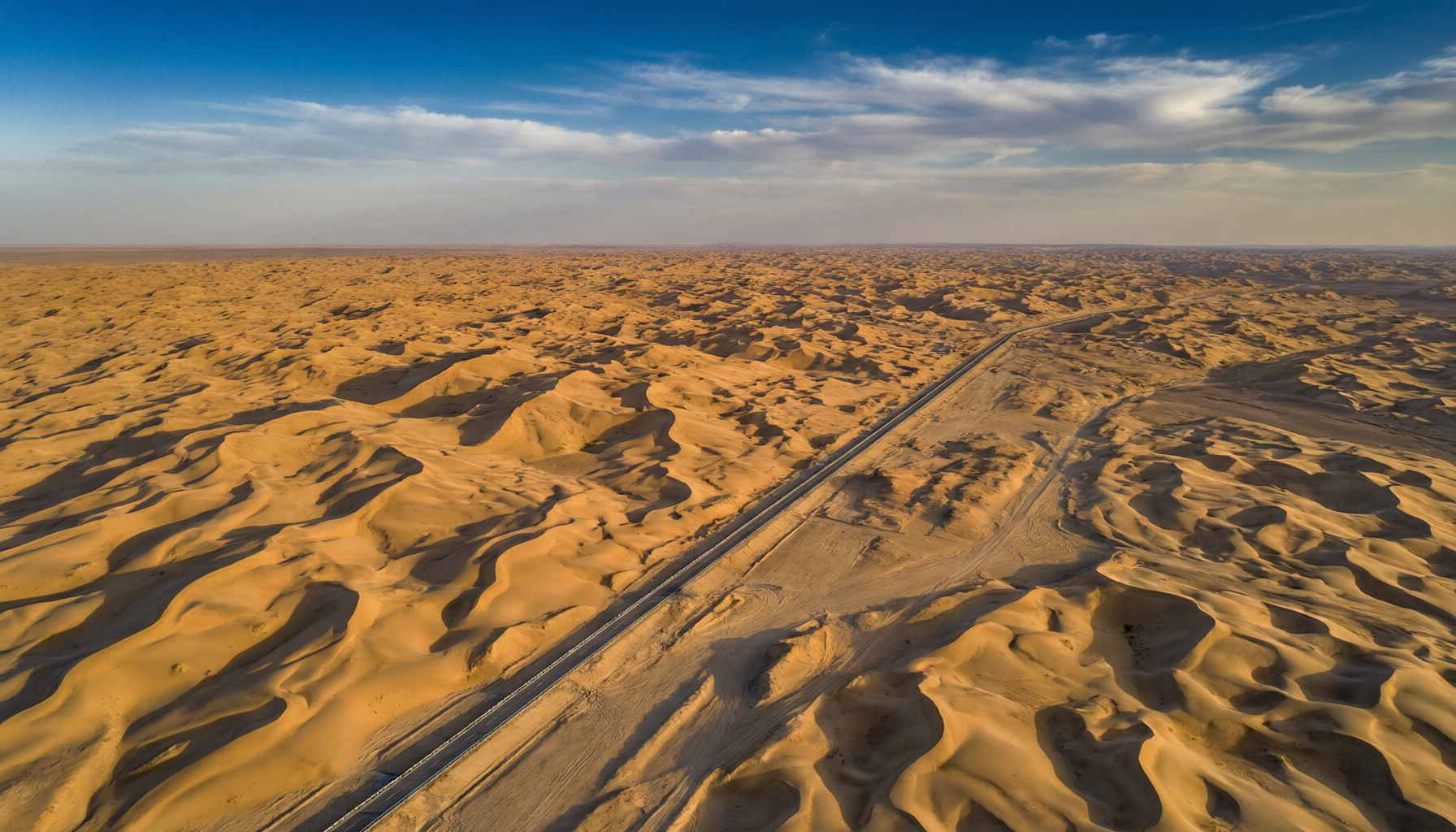
The Taklamakan Desert doesn't ease you in. One moment you're driving through orchards and poplar-lined irrigation channels; the next, the road stretches into an ocean of sand so vast it swallows the horizon. Covering 330,000 square kilometers — roughly the size of Germany — this is China's largest desert and the world's second-largest shifting-sand desert. Locals call it the 'Sea of Death,' a name earned over millennia by caravans that vanished into its dunes.
Yet today, paved highways cut straight through the heart of it, and adventurous travelers are discovering that the Taklamakan offers one of the most surreal road-trip experiences on Earth. Here's how to do it safely.
Quick Facts
| Detail | Info |
|---|---|
| Location | Central Tarim Basin, Southern Xinjiang |
| Size | 330,000 km² (1,000 km × 400 km) |
| Type | Shifting-sand desert (world's 2nd largest) |
| Gateway cities | Korla, Kuqa, Aksu, Hotan |
| Entry fee | Free (desert highways are public roads) |
| Best season | Late September – mid November |
| Nearest airport | Korla (KRL), Hotan (HTN), or Kuqa (KCA) |
| Recommended | 2–3 days minimum |
When to Go
October to mid-November is the golden window. Daytime temperatures hover around 15–25°C, the skies are crystalline, and the ancient poplar forests along the desert's edge turn brilliant gold. This is also when the Tarim poplar festival takes place, and the light conditions for photography are unmatched.
April–May can work if you're prepared for occasional sandstorms. Temperatures are pleasant (15–25°C), but visibility drops dramatically when winds pick up. Carry goggles and a face covering.
June–August is dangerously hot. Air temperatures reach 39°C and sand surface temperatures can exceed 80°C. The UV radiation is extreme. Only attempt desert crossings in summer if you have professional support.
The Desert Highways
Three paved routes now cross the Taklamakan — engineering marvels that transformed a weeks-long death march into a day's drive.
G216 — Luntai to Minfeng (522 km)
The classic crossing. This route passes through Tazhong, the desert's only supply town, and traverses the famous Tarim Poplar Forest — a UNESCO-worthy grove of thousand-year-old trees that turn gold in October. Allow 8–10 hours of driving. Fuel up in Luntai; the next station is 200+ km away.
G217 — Aral to Hotan (424 km)
The newer route crosses the western desert. Less traffic, more isolation. The reward is reaching Hotan — the ancient jade-trading city — where Sunday bazaars sell river jade and handwoven silk. This route has zero fuel stops, so start with a full tank and jerry cans.
G335 — Qiemo to Yuli (334 km)
The shortest crossing, ideal for a quick taste of the desert. You'll see dramatic dune formations and, with luck, wild Bactrian camels. This route is newer and less traveled.
What to Do
Camel Trekking
Available near edge towns like Korla and Ruoqiang. A half-day trek takes you into the dune fields where vehicles can't reach. Sunset rides are particularly atmospheric. Expect to pay 200–400 CNY per person.
Desert Camping & Stargazing
The Taklamakan's remote location and zero light pollution make it one of China's best stargazing destinations. Professional outfitters set up camps with windproof tents, warm bedding, and traditional Xinjiang dinners. The Milky Way is visible with the naked eye on clear nights. October and November offer the best conditions. Budget: 500–1,200 CNY per person for a guided overnight.
Tarim Poplar Forest
Located along the G216 near Luntai, these ancient trees are living fossils — some over 1,000 years old. In October, the golden canopy against blue desert sky is unforgettable. Entry: ~40 CNY. Allow 2–3 hours.
Dune Bashing
4×4 vehicles race up and down the dunes in a controlled rollercoaster experience. Available through tour operators near Korla and Hotan. Thrilling but not for those with back problems. 300–600 CNY per vehicle.
Suggested Itineraries
Express Desert Taste — 1 Day
Fly into Korla. Morning camel trek into the dunes. Afternoon drive along the G216 entrance section. Sunset photography. Return to Korla for dinner at a Uyghur restaurant.
Classic Crossing — 3 Days / 2 Nights (Recommended)
Day 1: Korla → Tarim Poplar Forest → overnight in Tazhong (basic guesthouse). Day 2: Full G216 crossing to Minfeng → drive to Hotan → jade bazaar. Day 3: Hotan Sunday market (if timing aligns) → fly out or continue to Kashgar.
Extended Silk Road — 5 Days / 4 Nights
Adds Kuqa (ancient Kucha), the Tianshan Mysterious Grand Canyon, a desert camping night with stargazing, and the Hotan jade market. This route pairs perfectly with the Duku Highway if you're combining both in a single trip. Contact us and we'll design the details around your preferences.
Plan Your Taklamakan Adventure
We specialize in premium, tailor-made Xinjiang itineraries — private 4×4 vehicles, professional desert guides, luxury camping under the stars. Every detail handled so you can focus on the experience.
Contact UsPractical Tips
Fuel — There are zero gas stations on any of the desert highways. Fill up completely before entering and carry at least 20 liters of reserve fuel. Running out of gas in the Taklamakan is not an inconvenience — it's an emergency.
Water & Food — Carry at minimum 5 liters of water per person per day, plus electrolyte supplements. Pack high-energy snacks. Cell service is nonexistent on most stretches.
Vehicle — A 4×4 is not required for the highways (they're fully paved), but essential if you plan any off-road excursions. Never leave the highway without a certified guide and satellite phone.
Clothing — Breathable long-sleeved shirts, UV-protection hat, sunglasses, SPF 50+ sunscreen, high-top boots with sand gaiters. Even in October, nights drop to 5°C — bring a warm layer.
Sandstorms — Most common in spring (March–May). If caught in one, pull over, turn off the engine, close all vents, and wait. Visibility can drop to zero in minutes.
Frequently Asked Questions
Yes, if you follow the highways and use professional guides for off-road excursions. The highways are well-maintained and regularly patrolled. The danger comes from venturing into deep desert without proper equipment and local knowledge.
Yes — the G216, G217, and G335 are all fully paved. A standard sedan is fine for the highway crossing. However, any off-road activity requires a 4×4.
The G216 (Luntai–Minfeng) takes 8–10 hours nonstop. Plan for 10–12 hours with stops for photography and rest. Most travelers break the journey with an overnight in Tazhong.
The most popular combination is Duku Highway → Kuqa → Taklamakan crossing → Hotan → Kashgar. This creates a grand southern Xinjiang loop of 5–7 days.
No. Independent camping in the Taklamakan is extremely dangerous due to shifting dunes, zero cell service, and the risk of sandstorms. Always use a professional outfitter with proper safety equipment.